Showing posts with label Educational Philosophy. Show all posts

Sunday, June 23, 2013

Encouraging a Love of Reading

My philosophy on teaching reading is far different from many homeschoolers I’ve met.  I believe that children can learn to read at a very young age.  Children younger than 3 are introduced to letter names and sounds though aren’t expected to retain the information.
            Once children are 3 years old they have the ability to learn letter sounds and how to use them at the same time.  We focus on one letter per week.  We do not learn the letters in alphabetical order.  We learn them in an order that presents the highest number of CVC words for them to sound out.  As we focus on a new letter each week we add it to the letters we've already learned to successfully read decodable texts. 
            When you give young children this power to successfully read they are so proud of themselves.  They look forward to utilizing their new found skills in increasingly difficult books.
            We can encourage a love of reading by providing children the opportunity to be successful readers.  Giving them the opportunity to be surrounded by books encourages them to pick up a book, even if it just means looking at the pictures.
            We also encourage a love of reading by demonstrating a love of reading.  We can take the opportunity to read for ourselves as well as read to our children.
            I love using a child’s interests to encourage them to read more.  My oldest (a kinder) has a set of picture encyclopedias.  His reading lessons go as follows:
·         *He gets to browse through all the encyclopedias any time he is interested.
·         *If he’s interested in something specifically we read the encyclopedia page about the topic.  He reads the words he can read and I read the rest.
·         *If that satisfies his thirst for knowledge on the topic we move on and browse again.
·         *If he’s still interested in a topic after we read the encyclopedia we find other sources of information.  Sometimes this means visiting the library, finding books around our home, or utilizing an online leveled book library.  We find a text on his reading level about the topic of interest.  We also find a text that is much harder that we can read together.  He takes both books and highlights the words he can read (either with a highlighter or highlighter tape).  This empowers him by giving him the responsibility to discover what he can do.
·         *Lastly, we read the books together, over and over.
As we read together children are improving their reading skills and learning about ideas or reading stories on a topic of interest.

            We read things according to our interest in the topic.  We love reading because it satisfies something within us.  The stories captivate us.  The non-fiction texts empower us with knowledge.  It’s crucial to give children the same satisfaction with appropriately leveled texts and support for their current skills. 

Sunday, June 2, 2013

The Importance of Field Trips

One aspect of my Educational Philosophy that I didn't touch on before has to do with field trips.  I don't think I've ever voiced my opinion about them before or stressed to families why I thought they should come.  Better break that silence and let the world know: Field Trips are an ESSENTIAL part of life, particularly in the educational years of children and youth.  Throughout this post you can see some snapshots of great field trips we went on in the 2012-2013 school year.
 In my view, you can only learn so much in a classroom.  There are constrictions and limitations.  Even if you let toddlers play with dirt on your carpeted classroom floor there is still more they could gain from a trip beyond your four walls. Field trips enable a barrage of things: interactive learning, rejuvenating entertainment, supplemental learning, social interaction and community awareness, exposure to new ideas and places, pride and self affirmation, connections from the real world to our lives, application of knowledge and skill development, and overall learning!
 We have had a great time going on field trips with our friends this year.  There have been some field trips that didn't turn out great (little advanced preparation) and some field trips that were exceptional learning opportunities for everyone (mega advanced preparation).  I keep pushing for intentional experiences with our children and I think field trips are a great opportunity to be actively engaged in your child's interests and share tidbits of knowledge along the way.  Don't think of it as a time to go on a lovely walk and gab with your mom friends (though there is a time and a place for that), think of it as a field study where the adult is consciously making an effort to expose children to new ideas and experiences.
 I believe that (in the preschool years especially) kids should have a small amount of focused and purposeful education and then expand their growing understanding of the world by being in the world.  Ever go to a job interview where they didn't ask about your "Real World" experience?  Yea, neither have I.  As we take our kids on excursions, or field studies, we are allowing their intuitive nature to learn outside of the classroom.  This is how they will learn and thrive as they grow older.  How do you learn as an adult?  For me, learning involves a lot of reading, hands on experiences, lots of reading, hands on experiences, and repeat. Shouldn't we do our children the same service?
 When I asked a friend about her view on the importance of field trips it was like I lit a fire under her.  She wrote many paragraphs on her thoughts.  Turns out I'm not the only one passionate about field trips, but not all for the same reasons.  My friend, Katrina, is a mom to two young girls.  For her it the importance of the field trips has been multiple fold.  She has learned and grown as a mother.  In her words, "Field trips with one child take getting used to with preparing the diaper bag, snacks, lunch, stroller or ergo, camera, etc. but once you get the hang of it field trips are a rewarding way to give your child a new experience and exposure to new ideas. With my first child, I was gifted and purchased some local memberships. Going with your child (just the two of you) can be fun and educational; however, in my experience I found field trips through a moms meetup group or through little adventures preschool so much fun, rewarding and educational. Kids get to learn from all the moms and from each other. The kids begin learning socialization in addition to having a new type of stimulus. I found that I learned so much from watching other moms use various discipline techniques such as love and logic vs. others. I got to see what it's like to raise boys vs. girls. I got to watch mom balance two, three and more kids. I began learning all the different ways to parent and how my child best responds to new information. The great thing about field trips is that I got the opportunity to see what interests my child. I would get to see her get excited about the train at the zoo or the space exhibit at the museum. I learned that she loves trains and could care less about other things at this time. I know her interests change and develop over time but going on field trips is a great indicator to me on types of activities I can create and focus on at home. After we went to the fire station for a tour, my daughter wouldn't put down her safety tot pack. She played with it for weeks, so I took her on another tour at a different fire station then took her to the children's museum to play on their fire truck. For about two months, my one year old loved fire trucks. Than we moved on to space after seeing an exhibit at the DNSM."
I would encourage you to think about field trips you could take your children on and what the purpose of those field trips would be.  Ask yourself a few key questions, "What is worthy and requiring of understanding? What is evidence of understanding? What learning experiences and teaching promote understanding, interest, and excellence?"  I'd recommend you get your hands on a book called "Understanding by Design" (I have a first edition copy if anyone wants to borrow it). When children are small these questions have simple answers, the important part of it (to me at least) is that we as the adults are taking on the responsibility of raising our children and sharing knowledge intentionally.  We don't just sit idly and discover that life has passed us by without a thought.  
 Knowledge and the opportunity for learning is everywhere.  I love what my friend Katrina told me today about preparing for a field trip (shall we say "Field Study"?).  "We are planning on going to the Space exhibit at the Nature and Science Museum. I have put together a bag of space activities to throw in my car including space do-a-dot printables and round stickers, books on space, a space tot pack with dry erase crayons, and space stickers. Since these materials are with me, I can pull them out during snack or lunch and supplement the learning. For example, counting all the moon rocks, looking for letters drawn in the wet sand exhibit, or talking about the various colors of the planets. If we are unable to do the activities at the museum then that evening, or the following day, I pull out those activities at home to reinforce the learning experience referring to what we saw the previous day. This allows me to tailor the learning in a way that is age appropriate for my child. Many exhibits try to appeal to various age ranges but might not be perfect for my child to get the most out of it, so I have an opportunity to optimize learning while my child is engaged, interested and having fun."
Don't expect your child to learn more simply by spending more time inside a classroom.  Prioritize field trips.  Get out and learn from the world.  And while you're at it, take the opportunity to "optimize learning while [your] child is engaged, interested and having fun."

Happy Learning!

Friday, May 31, 2013

Philosophy on Education

For my friends and readers who are pondering the education of their children:

As our children are young I believe it is important for us as parents to discover our own philosophy on education.  As a licensed teacher I've had the opportunity to explore many different teaching philosophies and fine tune my own ideas through years of schooling, teaching in public schools, raising small children, teaching preschool and homeschooling.

I currently organize a group of moms who all believe in being intentional in their parenting.  The education of their children is a top priority.  I consider it my "homeschooling group" although many of the parents don't home school their children in the "formal" definition of homeschooling.  I do believe that ALL parents home school their children even if they attend a formal school.  All children are learning from the get go and continue learning even outside formal school hours.  As parents, we are the most important educator of our own children.

For the families that are thinking about education for their children it is never too early to start intentionally discovering what it is that you want for your children and more importantly HOW you intend to facilitate that.

As you consider what form of schooling you'll expose your child to it is important for you to know what you value in education. Also consider the style of education you'd like for your child.  What is it that you want them to come away with?  What do you want them to know or be able to do? It is not only what your child will do but how they will do it.  How does your child learn best?  What goals do you have for your child?  It is important to learn what choices are available to you.  Different schools offer different types of teaching style, content and learning opportunities.  Is it a school you want for your child or a way of life?  Is having a teacher that only fills the role of "teacher" at the "school" important or can the teacher be yourself or a good friend?  If homeschooling is on the horizon what types of support can you build for your family that support your beliefs and desires?

Keep in mind there is no "right" answer and your opinions will change over time as you're exposed to new experiences in life. No one cares more about your child's welfare than you do.  You know your child's personality, strengths and weaknesses.  You know the interests that light up your child's eyes.  You know the values that your family wants respected in education.

I'd encourage you to ponder these things in your heart and talk about your views with family and friends that will help you nail down what you value in education.

My two bits (aka: my philosophy on education)...
Feel free to read the "About Us" page to learn a bit more about my philosophy on education.

I am homeschooling my two boys.  Sometimes I feel funny saying that because my oldest is only 4.  How can I really be homeschooling?  Well, quite honestly I always answer that question with a question. Who decided that you don't start learning until you're 5 years old or older?

I have been homeschooling my boys since birth.  We play games and explore the world together.  I am an advocate of intentionally parenting and providing children with undivided attention and treasures of information along the way.

I started a play group that ran successfully for a few years before we outgrew it. I ran a play date that I called "Little Learners" that was an opportunity for families to come over and explore different experiences based on a theme that I'd developed a lesson plan for.  I provided all the tools and the instruction to facilitate the parents in teaching their children.  Little Learners was extremely well attended.  Parents started asking if I'd teach their children through the preschool years to prepare them for their school years ahead.  That's when Little Adventures Preschool started.  Our formal preschool classes are a stepping stone for families into the education world.  I'm developing curriculum that I'd be doing with my boys regardless but for these few years we'll do it together with friends.  This fall our 3-5 year old preschool class will also host the parents for the last 15 minutes of each class to give us the opportunity to teach our parents what we learned and how they can expand on that learning at home.  I'm so excited for this new technique to get parents involved in their child's education.

My educational philosophy follows these ideals:

  • Children are ready to learn different concepts at varying ages.  I will always teach students at the level they are at rather than a level that any formal test says they need to be at.
  • When they're ready, children can learn the basics of reading and math.
  • While young and learning about life, I follow a more traditional teaching style.  The teacher is the boss.  The teacher creates lesson plans and researches the next steps for each child according to their needs.
  • After a child has learned the basics of reading and math a more scaffolded approach to teaching will naturally occur.  This means that the child will take more and more responsibility for their own education.  Education will become more theme or topic based.  Themes and topics will be chosen by the children.  We use encyclopedias to pick through topics that we're interested in learning more about.
  • As children grow older we'll merge more into an informal eclectic/natural learning/unschooling approach to education.  We will treat the whole world as our classroom and learn through play, reading and interaction with family and community.  Textbooks will be regarded as reference materials for self directed study and classes/experiences in the community will round out our education.      

I believe that we can teach our children to be active learners.  We can discover together how they learn best and facilitate that style of learning. Education is about the student.  Consider who your student(s) is(are) and what you can do to create the best learning environment for them. Maybe homeschooling is for you, maybe it's not.  There is no right or wrong.

To me, teaching and learning are exhilarating.  I never feel more energized than after a class that has gone well or when a teachable moment was seized and we've learned something new or explored a path that was previously not taken.  Isn't that love of learning something we want to pass on to our children?

Please swing by and vote for Little Adventures Preschool, we're holding spot #6 right now and I'd love your support. http://www.circleofmoms.com/top25/Top-25-Homeschooling-Moms-2013?trk=ps_menu_blogger

Thursday, October 4, 2012

Thoughts from a Little Adventures Mom

When my daughter was 6 months old, I joined Ms. Amanda's Little Adventurer's Group. I started using her tot packs at the beginning of this past summer (2012). I was extremely impressed on how the materials engage both the parent and the child. My daughter loves our educational time using the tot packs and they are useful for teaching concepts and ideas. At 18 month old, our pediatrician suggested that we get developmental testing because our daughter could use over 200 American Sign Language signs but was barely babbling and could speak less than 5 words. When I took my daughter in for her testing the team of experts said that they were surprised that Alexxa knew preschool, kindergarten, and even some 1st grade level concepts. I believe that these skills were developed by practicing the tot/preschool packs with the suggested activities at the front of each pack. I was never a school teacher or trained in education but the use of these materials have taught me to be a better parent and interact with my child with age appropriate activities. Although the packs take time to put together, the benefits of each pack is remarkable. I am continuously surprised when my daughter demonstrates the ideas presented in the packs in other areas of life. Ms. Amanda is extremely creative and designs easy to use materials that are fun, interactive, and educational. I would suggest these tot packs to families with young children because they make learning fun for both the child and the parent. Thank you Ms. Amanda for teaching me to be a better parent, educator, and an active participant in my child's learning. I appreciate your creativity and the materials you have made available to download. Thanks, Katrina

Friday, September 14, 2012

A Small Success

What is the true bottom line of Little Adventures Preschool?  I love teaching.  It really is that simple.  Who has the opportunity to greet each day with excitement and joy when starting "work"?  I do.  How many people can work all day and overtime through the late hours of the night and be completely motivated to do it again the next day? Me.  Some days are rough.  Ok.  Honestly, some moments are REALLY rough, but never rough enough to change my heart about what I do.  There is so much joy in my heart as I watch kids grow and accomplish whatever their heart desires.  We're super busy as we rush around hanging up wet painted artwork and digging through boxes of books to find the "just right" book for each child.  There are hundreds of hugs to be handed out and successes to reward with a high-five and a smile.  The love is what makes it all worth it.

Today I took CJ (and EMan) to the library.  It has been a while since we've been but since we started talking about interest led learning in preschool B and he decided he wanted to learn all there is to know about construction trucks we made a quick (30 minute) stop on our way to the dentist office field trip. We asked for a little assistance to lead us to the non-fiction "Things That Go" section and CJ immediately plopped down on the floor thumbing through a stack of books to pick out the ones that were the most interesting to him.  It made me smile in my heart to watch him (3 years old) just devouring up books.

We went to the dentist field trip and had a fantastic time there.  On our way home CJ pulled out one of the books we'd gotten from the library.   From the back seat I hear, "/c/.../e/.../m/.../e/.../n/.../t/, cement /t/.../r/.../u/.../c/.../k/, truck.  Cement Truck." It was all of 30 seconds, but it was the most delightful 30 seconds of my day.  CJ, who will be 4 in January, is reading.  And not the simple "easy readers" that I've been showing him.  Big words.  Like cement truck.  Not because he is a fantastic reader, but because he has the internal motivation and drive to use a few skills that I've taught him to read something that is important to him. 

What is the true bottom line of Little Adventures Preschool? I love teaching. It really is that simple.

Monday, August 20, 2012

Welcome to Preschool!

Welcome to preschool friends!  I can't believe that I forgot to grab my camera at the start of the day, but we certainly had a great day!  Preschool A utilized the "Welcome and Manners" preschool pack thoughout the day to enhance our learning. Here are a few great pictures from the day (be sure to scroll down for Preschool B in the afternoon).

 Snack time.

 Painting.
 Washing faces and hands :)
 Math - quantity of 1.

 Watching "The Napping House".
 Replaying the "Napping House" to continue our conversation about the quantity of 1.
 Little Jack Horner game.
 Music exploration.
 Preschool B learning about their choices for the day.
 Picking what items they'd like to use in art.

 Art time!

 Picking what they'd like to do for music.
 Hand Bells was the winner!

 We made a nice fruit smoothie and enjoyed peas for snack time.

 Quantities up to 5.
We had a great first day of school!

Saturday, August 18, 2012

A New Way of Thinking

First, a fun congratulations to Kelly, Penny, and Katrina for winning our giveaway!  Kelly will be receiving the book in the mail as soon as I get a mailing address from her and Penny and Katrina will be receiving the Feelings Tot Pack, coming soon!

I'm working on a new way of thinking about education.  I was traditionally schooled, and it worked for me.  I've also taught in a few public schools and that was fantastic as well.  Now, as I study more about my children I am ready to start releasing some of the responsibility for their education to them, or at least to CJ who will be four in January.  I think it's important to teach our children some of the basics when they are interested in the preschool years.  He's already learned his letters, sounds and how to blend words together when dealing with short vowel sounds.  We're still working on some advancing reading skills and basic math skills, but I've recently bought him an Encyclopedia which he loves reading with me.  For Preschool B I'll be giving him and a few other kids the opportunity to make more choices about the subject we learn from.

I intend to use the following subject labels on a large magnetic board (oil pan).  The only thing that will have a set time will be snack.  Each day I'll start with a group time activity, introducing different concepts and ideas for the day and having calendar time.  Next, I intend to lead a discussion regarding our "To Do" list.  We will organize the subjects according to the schedule that we agree upon every day.
Reading will involve some one-on-one literacy lessons, I'm using Ready2Read and the Amazing Action Alphabet according to needs.  The reading block will also involve students working on individual or small group projects.  As children discover their passions, individual and small group projects will relate to what they're studying about, while furthering their reading ability.  

Math will follow the TouchMath PreK curriculum for August-December (ish).  According to student needs we can move into the TouchMath Kindergarten curriculum for the remainder of the year.

Music will be entirely student choice. Using the following cards we'll pick what we'd like to do for the day.  In the beginning of the year we'll all do the same thing.  As we start to master the concept of choice and responsibility for that choice students will get to pick what they'd like to do individually.  Musical concepts will be taught as appropriate.
Snack will involve picking what we'd like to eat, preparation and clean up.  Each day will have 2 choices.  I'm working on cards that represent different snacks.  Depending on what I have on hand I'll pick 2 cards that would be options. 
I wish I could share these cards, but I don't have the license from the artist :(
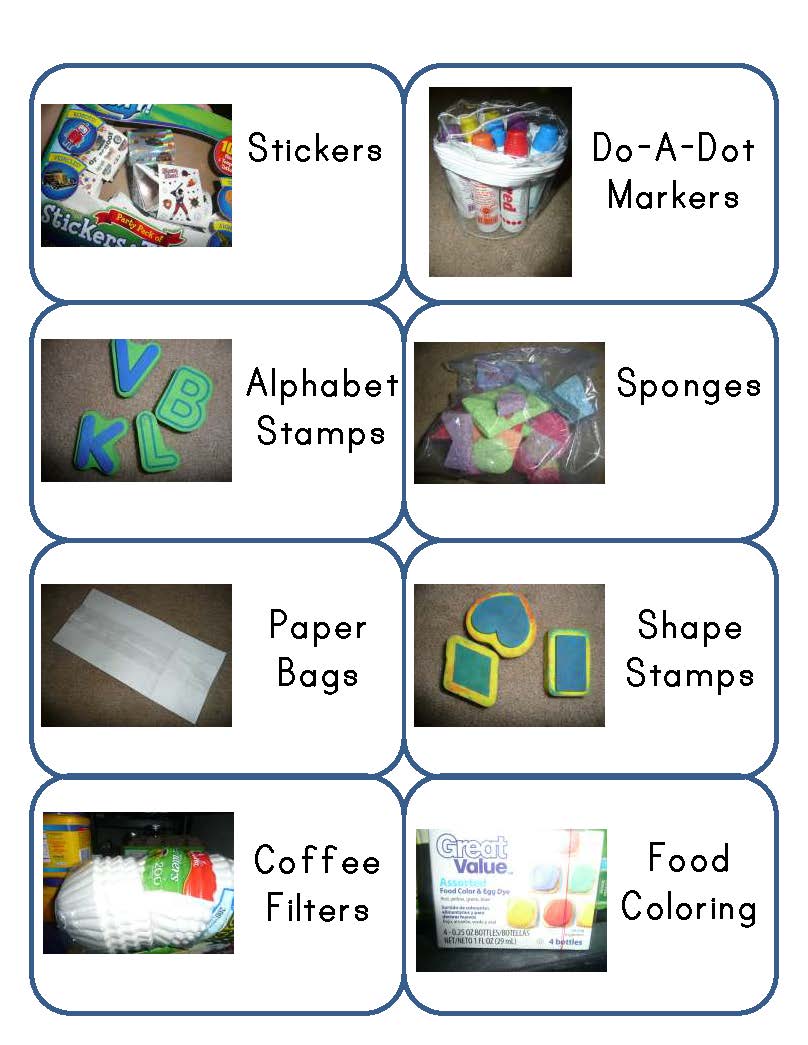
Art will be entirely student choice.  From a variety of art supply cards we'll pick a few that represent what we'd like to use for art.  Students will be welcome to use their journals, loose paper, foam, play-dough, and many other items.  In September we'll start talking about each child's passion.  As we use their passion to further their reading, writing and math skills we'll also be able to tap into that passion to create artwork around it.   
Writing will primarily be embedded throughout the day.  I'll pull it out to add to our day when we have times that need a specific art block.

Thursday, August 16, 2012

Where to find curriculum

Many of you are looking for the curriculum packs as soon as they are released.  That's great because it will give you a minimum of a week to prepare to teach it.

Have you noticed the tabs at the top of the blog? If you are following along at home you'll want to book mark the "Tot School" tab if you're looking for toddler curriculum and the "Preschool A" tab if you're looking for preschool curriculum. As each new pack is released they will be updated there, and quite possibly not featured on a blog post.

There will be oodles of packs coming out (about 40 tot packs and 75 preschool packs).  I've decided to feature the packs the week that we use them in my home, which will be about 2 weeks after they are available for you to download. 

So head on over and find what's new!
Don't forget to enter our book giveaway in the next few hours: http://www.littleadventurespreschool.blogspot.com/2012/08/today-i-feel-silly-book-giveaway.html

Also, don't forget to download the August printables!
http://www.teachersnotebook.com/shop/LittleAdventuresPreschool

Wednesday, August 8, 2012

How I Put Together Tot Packs and Preschool Packs

I spend hours and hours researching and creating the best lesson plans possible for my children.  This year I have been encouraged to spend many more hours writing those lesson plans down and creating preschool and tot packs to share.  The August packs (coming soon, like maybe tomorrow...) will be a free download for one week.  After the week expires, all packs will have a small fee.  I'm talking super small - like $2 per month of packs.  Each month will have 8 Preschool Packs or 4 Tot Packs.  They will also be available individually for $1 each.  You can download everything at http://www.teachersnotebook.com/shop/LittleAdventuresPreschool

Before you get your hands dirty diving into curriculum I wanted to give a little tutorial on how I put my packs together to use at our house.  You can feel free to copy me, or do things in a manner that works for you.

These materials are intended for a small preschool classroom, but can easily be tailored to homeschooling families with just one or two kids.  They could also be used in a playgroup setting of homeschooling preschoolers or toddlers. 

I like to print all the pages of my packs, cut and laminate as needed, and bind them into books with a comb binder.  I use a lot of Velcro to attach the loose pieces into the book.  This way I have most of what I need in a handy packet.  To see pictures of a bound pack, go {here} and scroll down to the photographs.

To find a list of materials and resources that I use in my home, go {here}.  Please do not be afraid when you see this list :) Materials accumulate over time.

Now, on to How I Put Together Tot Packs and Preschool Packs, A Tutorial

Step 1: Print all the pages in the pack.  I don't print the very first page.  You can choose to print the pages you'll use.

Step 2: Divide pages into to categories: pages to cut, pages not to cut.

Step 3: Grab a stack of laminating pouches.
 Step 4: Slide the first pages into the laminating pouch.
Step 4 Note: Pages that are not cut get placed in the laminating sheet back to back, make sure your pages are in order though.  If you are uncertain of the order, check the "Printables in this Pack" portion of the lesson plans.
 Step 4 Note: It is very difficult to see, but I put the pages in the laminating pouch slid all the way to the top and closer to the right side of the pouch.  Make sure the right side still has 1/4 inch of lamination around the outside of the pages though.  I do this because the binding machine cuts into the left hand side. (Just as a side note, the product used for this tutorial is a fantastic free download about teaching manners by Kathleen Pedersen.  Find the free download here.)
 Step 5: Grab your trusty thermal laminator. Turn the laminator on to medium heat or the 3mil setting.  Once it's hot...
 Step 6: ...Insert lamination packs into the feed end of the laminator, sealed end first.  Make sure you put them in straight or else the edges will get crinkled and ruined.
 Step 7: Let the laminator pull the paper through by itself.
 Step 8: Make sure the laminator is in a place where the lamination can come out and lay flat while it cools down.
 Step 9: Cut all pages that needed to be cut before laminating.  I cut, laminate, and cut again so that when kids put things in their mouths or when I wash off the wet erase marker the inside paper doesn't get ruined by the moisture.  It has a laminated seal around all edges.  Some items need to be cut out like playing cards.  Other items need to be cut around the picture.  When cutting around a picture I aim for leaving 1/8-1/4 inch of white around the object.
Step 10: Once the pieces are cut, put them inside laminating sheets.  Cut pieces don't go back to back unless specified.  Make sure to leave enough space between items that you can cut each item out with about a 1/4 inch of lamination around it.  Laminate, just like above.
 Note: When picking up sheets to laminate they tend to stick together.  Rub the top edge and separate it from any extra lamination sheets.
 Step 11: Grab your handy dandy comb binding machine.
 Step 12: Grab 1/2 inch binding combs and put it on the binding machine.
 Step 13: Organize your laminated full sheets of paper into the order you would like them.
 Step 14: Slide 2 laminated pouches in at a time (left hand side of the book goes in, face down).  Press them firmly against the back of the machine, there is very little room for error if the pages aren't touching the back.
 Step 15: Pull down the binding machine lever to cut the pages.
 Note: The binder will only cut the small rectangular holes in the lamination if you put the papers inside closer to the right side of the pouch.  This is ideal because the paper inside still maintains a seal around the perimeter.
 Step 16: Thread the pages onto the comb.  Repeat until all pages of the book are threaded on.
 Step 17: Your book is now bound, remove it from the binding machine.
 Step 18: Cut out all the pieces that go inside the book, being certain to leave 1/4 inch of lamination around all edges. Pages that don't go into the book can go in a plastic bag.  There will be some mini books.  Just hole punch the top left corner and bind them into books with binder rings.
 Step 19: Attach Velcro dots (or cut Velcro strips) to the book.  I like to stay consistent and put the hook side of Velcro (rough side) on the pages and the loop side of Velcro (soft side) on the pieces. I put the Velcro on the book first and then pull of the backing, exposing the sticky side of the loop Velcro.  Then I line the pieces up and press them down onto the paper.  That way the Velcro lines up when kids match the picture.
 Step 20: Pages like the "Stop and Go Dancing" page have pieces that I like to attach craft sticks to.  I simply attach the Velcro at the top of the picture so that the craft stick can be attached and left in the book.
 Step 21: Grab a pack of wet erase markers to color and write on the pack.  Wet erase cleans off easily with a damp rag or baby wipe.  Dry erase works too, but it doesn't wipe off as cleanly and will stain your lamination.
 Step 22: Drop the packs and extra pieces into a hanging file labeled with the month or theme.  I also like to store books that I own that go along with the theme in the folders as well.
All done!
You certainly don't have to do all this work, but if you intend to use them for multiple years with multiple children I'd highly suggest it.

Watch for the release of all the August packs in the next day or two and get ready to start having fun!